
Real People, Real Reminders: Why Human Led Medication Prompts Can Work Better Than Apps
Automated reminders are everywhere, push notifications, text alerts, and app badges. They can help at the start.
But if adherence were solved by alerts alone, we would not still see adherence rates hovering around half for many long term therapies.
For many patients, the missing ingredient is not another ping. It is support that feels human, consistent, and trustworthy.
The strengths and limits of automated reminders
Digital reminders have real benefits.
- Low cost and easy to scale
- On time prompts
- Useful for simple regimens
Systematic reviews show that text messaging interventions can improve medication adherence in many settings and conditions. But results vary, and reminders alone do not solve barriers like side effects, confusion, cost, and low motivation.
Why human led prompts change the psychology
Human led support works differently because it adds three things technology often cannot deliver well on its own.
Trust
Hearing and seeing a real person can increase attention and credibility.
Accountability
A live check in creates a social expectation. Many people follow through more when they feel supported and noticed.
Problem solving
A human can clarify instructions, address concerns, and escalate issues when needed.
What research says about human support
Evidence across reviews suggests that healthcare professional led interventions can improve adherence for many patients, especially when the approach includes follow up and barrier removal.
For example, a meta analysis of pharmacist led interventions in older adults found a significant improvement in medication adherence among those receiving pharmacist led support.
A 2024 systematic review of nurse led interventions reported that nurse led face to face visits may be effective in improving medication adherence in people with chronic diseases, though results can vary and more research is often recommended.
Why complex, supportive programs beat simple reminders
Cochrane evidence on adherence interventions emphasizes a practical point. For long term treatments, effective interventions are often more complex than a single reminder. They may combine education, follow up, practical support, and ongoing reinforcement, and not all interventions improve clinical outcomes.
This matches what care teams see. Patients need help with real barriers, not just clocks.
When human led reminders are especially valuable
- Complex regimens or frequent medication changes
- Low health literacy or low confidence with instructions
- Side effects, fear, or skepticism that reduce persistence
- Cost barriers and refill gaps
- Older adults and non app users
- Caregiver supported households where shared visibility helps
The hybrid approach is often the sweet spot
This is not an anti technology argument. Technology can deliver consistent prompts and tracking. Humans deliver meaning, trust, and problem solving.
The strongest programs often blend:
- A reliable channel for the prompt
- Human reinforcement and barrier resolution
- Clear escalation rules when something is missed
How Elevion applies human led adherence support
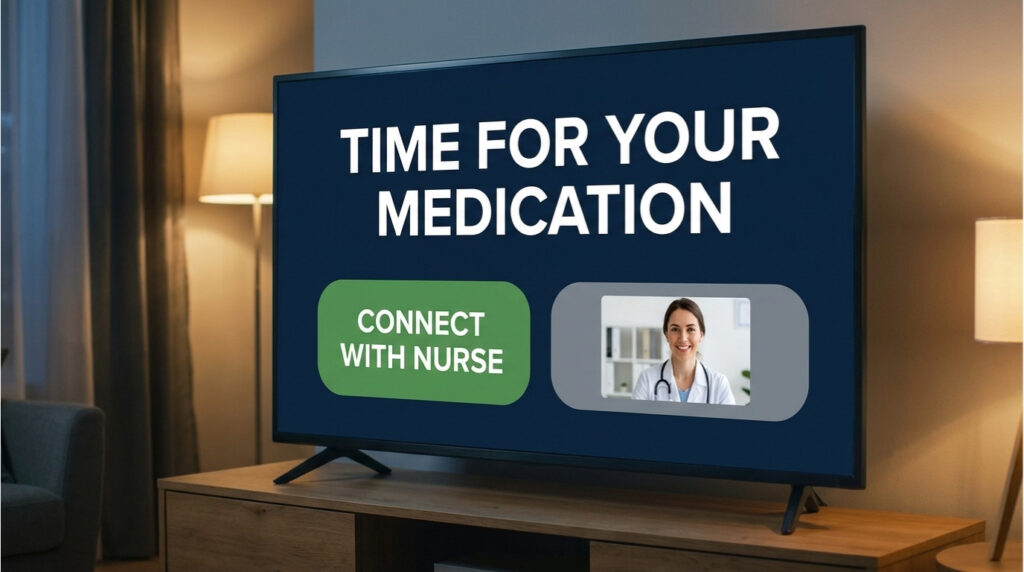
Elevion provides live, daily medication support through smart TV and simple phone touchpoints. The focus is practical.
- Confirm medications and dosage
- Provide a brief wellness check
- Follow up when something is missed
- Keep the experience familiar and supportive
Next steps
If you want to explore human led medication prompts through TV and phone, schedule a call with Elevion to discuss your population, workflows, and how to measure adherence improvements.
Medical note: This article is for information only and is not medical advice.
References
- Sarabi RE et al, Systematic review on mobile phone text messaging and medication adherence, 2016
- Marcum ZA et al, Pharmacist led interventions to improve medication adherence among older adults, meta analysis, 2021
- Berardinelli D et al, Nurse led interventions for improving medication adherence, systematic review, 2024
- Cochrane, Ways to help people follow prescribed medicines, CD000011
- World Health Organization, Adherence to long term therapies, Evidence for action, 2003